Fire
The alarm sounds, every screen shows the exit route and the assembly point.
Features Emergency broadcast
When something is wrong, the screens already on the walls are the fastest way to tell everybody. Nothing to unlock, nothing to install, nothing to hear over a noise.
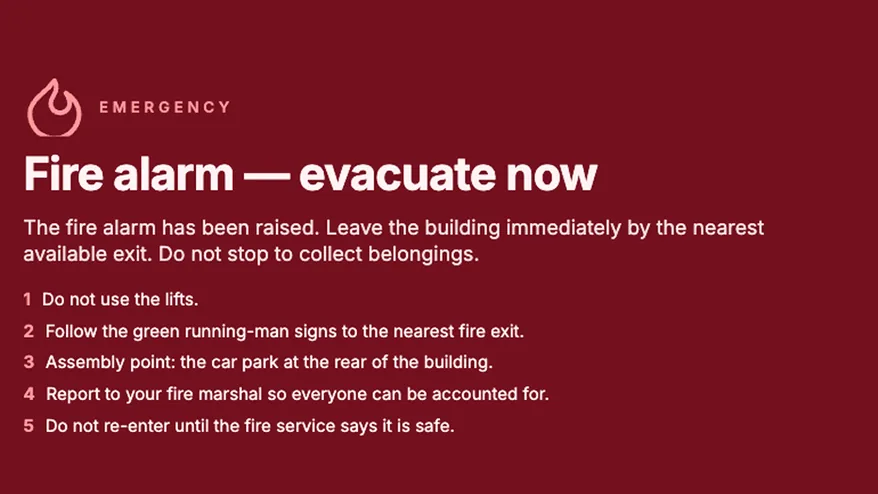
Choose a template, press once, and every screen on the account drops what it was doing and shows it — full bleed, high contrast, readable across a room. Ending it puts everything back exactly as it was.
Templates are prepared in advance, because nobody composes clear instructions during an emergency. Each carries a severity, a heading and what to actually do.
A Raspberry Pi screen can have a real button on its GPIO header, tied to a template you choose. Press and hold, and the broadcast goes out. The same input can be driven by a relay on a smoke or intruder alarm, so the screens follow the alarm without anybody reaching for a phone.
The button sends no message of its own: it names nothing and carries nothing, so a shorted wire cannot invent an announcement.
The alarm sounds, every screen shows the exit route and the assembly point.
A button by the bed or in the bathroom puts a message on every wall in the house.
No. It is on every plan, including free. It is not a feature to sell somebody in an emergency.
Yes — the broadcast is sent from the service to your screens. A wired button on the same screen needs the screen to be online to send it.
Yes, and you should. Send it, look at the walls, and end it.
Start free on one screen. No card until you add a second.